How to Create a Professional Resume in 2027: 7 Powerful Secrets to Get Hired Instantly
If you want to know how to create professional resume formats that consistently bypass rigid corporate filters and command the immediate attention of elite hiring managers, you have arrived at the definitive masterclass. In today’s hyper-competitive and increasingly automated labor market, sending out a generic, outdated CV is the fastest way to guarantee your application gets buried in the rejection pile. Every single day, thousands of highly qualified job seekers completely sabotage their own career trajectories simply because they fundamentally misunderstand the modern anatomy of a winning application document. It is not just about listing your past job duties or formatting your contact information neatly on a page.
Instead, it is about strategically positioning your unique professional value, quantifying your direct impact, and mastering the psychological triggers that HR directors look for when scanning hundreds of documents under tight deadlines. When you create professional resume structures the right way, you instantly elevate yourself from a disposable candidate into a must-interview industry asset. Throughout this comprehensive step-by-step guide, we will unpack the closely guarded secrets of elite recruiters, giving you an unfair advantage in your job search. By the end of this blueprint, you will be equipped with actionable, data-driven strategies that will transform your blank document into an irresistible interview magnet.
1. The Ultimate Blueprint: Why You Must Create a Professional Resume Now
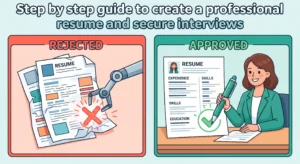
If you have been aggressively applying for dozens of high-paying roles but are only receiving generic, automated rejection emails in return, the underlying issue is rarely a lack of skill or insufficient experience. More often than not, the problem lies entirely in how you visually and textually package your career history. To truly succeed, you must learn to create professional resume layouts that communicate your absolute highest value within a matter of seconds. According to recent eye-tracking studies conducted by top recruitment agencies, an average hiring manager spends a mere six to seven seconds initially scanning a document before making a harsh, split-second decision about your future.
This means you do not have the luxury of burying your best accomplishments on the second page or hiding your core competencies behind massive, unreadable walls of text. You must immediately hook the reader’s attention by placing your most impressive data points front and center, ensuring that every single word serves a distinct strategic purpose. When you commit the time to properly structure your document, you are signaling to prospective employers that you are meticulous, organized, and deeply serious about your career trajectory. Do not underestimate the incredible power of first impressions; in the digital age, your CV is your ultimate ambassador. By mastering modern resume formatting techniques, it speaks loudly on your behalf before you ever step foot inside an interview room.
2. Understanding the Hiring Manager’s Mindset in 2027
To effectively create professional resume documents that generate endless interview requests, you must first step out of your own shoes and enter the highly stressed, time-poor mindset of a modern HR director. Recruiting professionals are completely overwhelmed, often juggling dozens of open requisitions while drowning in a sea of unqualified applications. They are not reading your document to learn about your life story or your generic hobbies; they are aggressively scanning your page looking for immediate, risk-free solutions to their specific corporate problems. You must understand that hiring is fundamentally an exercise in risk mitigation. Employers want absolute certainty that if they invest a lucrative salary in you, you will deliver measurable returns and seamlessly integrate into their existing company culture.
Therefore, your written content must proactively answer their unspoken questions before they even have the chance to ask them. By aligning your documented experience with their exact pain points, you instantly position yourself as the ultimate problem solver rather than just another desperate job seeker. Furthermore, modern recruiters are highly trained to spot empty buzzwords and meaningless corporate jargon. Instead of explicitly stating that you are a “hard worker” or an “innovative thinker,” you must unequivocally prove these traits by highlighting concrete situations where your direct actions resulted in tangible, quantifiable benefits for your previous employers.
3. Core Elements of a Winning Resume Structure
Whenever you sit down to create professional resume templates from scratch, you must recognize that architectural layout and structural hierarchy are just as important as the actual words you type. The human eye naturally follows specific reading patterns, typically scanning a page in an F-shaped or Z-shaped trajectory. If your document is cluttered with wildly inconsistent fonts, microscopic text sizes, or chaotic margins, the reader will experience immediate cognitive overload and toss your application straight into the digital trash bin. A high-converting document is built upon a foundation of clean, minimalist aesthetics and aggressive whitespace optimization.
You must divide your content into clearly defined, distinct sections: a powerful executive summary, a heavily optimized core competencies list, a reverse-chronological professional experience timeline, and a concise educational background. Each of these critical sections must seamlessly flow into the next, effortlessly guiding the recruiter’s eye down the page without any unnecessary friction. Additionally, you should heavily rely on sharp, punchy bullet points rather than dense, exhausting paragraphs when detailing your previous job roles. Whitespace is your ultimate ally; it allows your most impressive achievements to breathe and stand out, making it infinitely easier for exhausted recruiters to quickly digest your professional value and instantly move you to the next stage of the hiring pipeline.
4. Crafting a Powerful Summary That Grabs Attention
The executive summary sits at the very top of your document and serves as your premium, high-stakes elevator pitch. If you want to create professional resume profiles that instantly captivate an audience, you must absolutely abandon the deeply outdated concept of an “Objective Statement.” Employers do not care about what you want from them; they strictly care about what massive value you can bring to their organization. Your summary must be a tightly woven, three-to-four sentence paragraph that aggressively highlights your current professional title, your absolute biggest career achievements, and your unique value proposition.
Think of this section as the cinematic movie trailer for your entire career; it must be thrilling, concise, and incredibly persuasive. You should strategically inject relevant industry keywords into this section, ensuring that you speak the exact same language as the hiring manager reviewing your file. For example, instead of weakly stating that you are a “marketing professional seeking new opportunities,” you should boldly declare yourself as a “data-driven digital marketing strategist who has successfully scaled e-commerce revenues by forty percent through targeted SEO campaigns.” This aggressive, results-oriented approach immediately establishes your elite authority, forcing the recruiter to read the rest of your document with immense respect and heightened anticipation.
5. Mapping Out Your Professional Experience The Right Way
The professional experience section is the beating heart of your entire application, and it is precisely where you must decisively prove your worth. As you create professional resume histories, you must list your previous roles in strict reverse-chronological order, starting with your current or most recent position and working your way backward. However, the most catastrophic mistake job seekers make is treating this section like a boring, generic copy-and-paste job description. HR managers already know what a standard accountant or software engineer does on a daily basis; they want to know exactly how well you did it compared to everyone else.
You must transform your bullet points from passive duty statements into aggressive, action-oriented accomplishment statements. Begin every single bullet point with a powerful, dynamic action verb—words like “orchestrated,” “spearheaded,” “engineered,” or “maximized.” By utilizing strong language, you immediately frame yourself as a highly proactive leader who takes total ownership of their workflow. Furthermore, you must aggressively ruthlessly eliminate any outdated or entirely irrelevant jobs that do not directly support the specific narrative of the role you are currently targeting. You can learn more about highlighting impactful career achievements to ensure every single line of text on your page explicitly justifies its existence by clearly demonstrating your immense upward mobility and your relentless professional growth over time.
6. Highlighting Achievements Over Basic Responsibilities
If there is one absolute, non-negotiable rule you must follow when you create professional resume content, it is the strict mandate to quantify your achievements with hard, undeniable numbers. Metrics, percentages, and solid financial figures are the universal language of business success. When you include specific data points, you provide the recruiter with a tangible scale to properly measure your impact, making your claims completely indisputable. Did you simply “manage a team,” or did you “direct a cross-functional team of fifteen engineers to deliver a multi-million dollar software deployment two weeks ahead of schedule”?
Did you just “improve sales,” or did you “skyrocket quarterly revenue by thirty-five percent within the first six months of tenure”? The monumental difference in psychological impact between those two framing methods is exactly what separates the hired candidates from the endlessly rejected ones. Even if you do not work in a strictly numbers-driven field like sales or finance, you can always find highly creative ways to quantify your daily workflow. You can easily measure the sheer volume of tasks completed, the exact size of the budgets you expertly managed, the specific number of clients you successfully onboarded, or the exact percentage of time you saved by aggressively streamlining inefficient legacy processes. Numbers completely eliminate ambiguity and instantly prove your elite competence.
7. The Hidden Rules of ATS (Applicant Tracking Systems)
Before a human being ever lays eyes on your application, it must first survive the brutal, unforgiving scrutiny of an Applicant Tracking System. When you create professional resume files for corporate giants, you are essentially programming a highly sensitive document to bypass an advanced robotic gatekeeper. These sophisticated software algorithms are explicitly designed to scan your text, extract highly relevant data, and assign you a specific match score based entirely on your keyword density. If your document is poorly formatted or lacks the exact terminology requested in the original job posting, the ATS will instantly reject your file without a second thought.
To dominate the ATS, you must adopt a highly analytical, SEO-driven approach to your writing. You must carefully dissect the target job description, identifying the precise technical skills, core competencies, and mandatory certifications the employer is desperately seeking. Once you have compiled this master list of keywords, you must organically weave them throughout your executive summary, your skills section, and your professional experience bullet points. Do not attempt to forcefully stuff keywords out of context, as the human recruiter who eventually reads your file will immediately penalize you for unnatural phrasing. Strategic keyword placement is the ultimate secret weapon for ensuring your flawless document actually reaches the hiring manager’s desk.
8. Strategic Keyword Placement for Maximum Impact
Now that you understand the immense power of Applicant Tracking Systems, you must learn exactly how and where to inject these vital keywords without sounding like a robotic algorithm yourself. When you decide to create professional resume drafts, your absolute primary focus must always remain on human readability. Merely dumping a massive list of buzzwords at the very bottom of your page in a tiny, invisible font—a tactic known as keyword stuffing—is an outdated, severely penalized black-hat trick that modern HR software instantly flags and rejects. Instead, you must systematically scatter your targeted industry terms throughout the most prominent, high-visibility zones of your document.
Start by integrating exact-match phrases into your professional headline and your executive summary. If the job description repeatedly asks for “Agile Project Management,” ensure that exact three-word phrase appears organically in the first two sentences of your profile. From there, seamlessly weave these critical terms into your job experience bullet points by combining them with your quantifiable achievements. For instance, rather than having a standalone skills section that simply lists “SEO Strategy,” you should write a bullet point that states, “Spearheaded a comprehensive SEO strategy that increased organic landing page traffic by fifty-five percent.” Context is absolutely everything; when an ATS scans your file, it looks for relationships between keywords and your actual, provable career history.
9. Tailoring Your Resume to Specific Job Descriptions
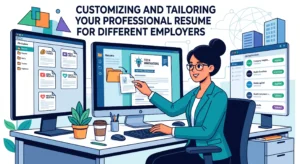
One of the most catastrophic mistakes that job seekers consistently make is utilizing a single, generic document and mass-distributing it to fifty completely different companies. If you truly wish to create professional resume portfolios that yield a high conversion rate, you must treat every single application as a highly targeted, bespoke marketing campaign. Hiring managers are remarkably perceptive; they can instantly tell when they are reading a generalized, one-size-fits-all CV because it fundamentally fails to address the unique, specific nuances of their particular organization. You must commit to aggressively customizing your content for every single role you apply for.
The most efficient way to execute this strategy without burning yourself out is to build a master document—an extensive, multi-page file containing every single achievement, bullet point, and skill you have ever acquired over your entire career trajectory. When you find a promising open position, you simply duplicate this master file and ruthlessly delete everything that is not one hundred percent relevant to that specific job posting. This dynamic process ensures that the remaining information is highly concentrated, hyper-relevant, and perfectly aligned with the employer’s immediate needs. Tailoring does not mean lying or exaggerating; it simply means adjusting your spotlight to heavily illuminate the exact skills the company is desperately trying to buy.
10. Showcasing Soft Skills vs. Hard Technical Abilities
In the rapidly evolving corporate landscape of 2026, where artificial intelligence and deep machine learning algorithms can execute highly complex technical tasks, employers are placing an unprecedented premium on human-centric soft skills. While you definitely need to create professional resume sections that meticulously list your proficiency in advanced software, coding languages, or data analytics, your hard skills merely get your foot in the door. It is your exceptional emotional intelligence, cross-functional collaboration, and crisis leadership abilities that actually convince the hiring committee to extend a lucrative job offer. The true challenge, however, lies in properly demonstrating these intangible qualities on paper.
You absolutely cannot just write the words “excellent communicator” or “natural leader” and expect the recruiter to blindly believe you. These empty, subjective claims hold absolutely zero weight in a competitive hiring environment. Instead, you must aggressively prove your soft skills through highly detailed, situational storytelling within your bullet points. If you want to showcase adaptability, describe a specific instance where you successfully pivoted a failing project under intense time constraints. You can explore a deeper breakdown on communicating critical emotional intelligence metrics to understand how top executives validate leadership potential. By attaching a concrete result to an interpersonal skill, you transform a vague, meaningless cliché into an undeniable, high-value asset.
11. Choosing the Right Resume Format: Chronological or Functional?
Selecting the correct foundational architecture for your document is a critical strategic decision that can either highlight your massive career momentum or dangerously expose your biggest professional vulnerabilities. When you set out to create professional resume structures, you will generally choose between three primary formats: the traditional reverse-chronological, the highly specialized functional, or the dynamic hybrid format. For ninety percent of all modern job seekers, the reverse-chronological layout is the undisputed gold standard. It lists your work history sequentially, providing hiring managers with a clear, logical, and highly predictable timeline of your upward mobility, increasing responsibilities, and overall career stability.
On the opposite end of the spectrum is the functional format, which aggressively groups your experience by specific skill sets rather than chronological timelines. While historically recommended for individuals with massive employment gaps, modern recruiters heavily despise the functional layout. It creates deep suspicion, as HR professionals instantly assume you are deliberately trying to hide a chaotic work history. Furthermore, older applicant tracking systems often completely crash when attempting to parse functional documents, leading to automatic rejections. If you are a radical career changer who desperately needs to emphasize transferable skills over linear history, you should utilize a hybrid layout. This allows you to forcefully highlight your core competencies at the top while still maintaining a clear, easily readable timeline below.
12. Addressing Employment Gaps with Confidence and Honesty
In the wake of recent global economic fluctuations, widespread corporate restructuring, and massive industry layoffs, employment gaps have become incredibly common and are no longer the immediate career death sentence they once were. However, when you create professional resume timelines, leaving large, unexplained voids of time completely blank is still a major red flag that breeds unnecessary suspicion. Human psychology naturally gravitates toward the worst-case scenario; if a recruiter sees a two-year gap with zero context, they will subconsciously assume you were unemployable or deeply stagnant. You must take proactive, absolute control of your own professional narrative by addressing these gaps head-on.
Watch this expert breakdown on explaining career gaps gracefully to elite employers :
Instead of attempting to deceitfully manipulate your employment dates—which will instantly be uncovered during a routine background check—you should proudly document your time away as its own distinct entry. If you took time off for intensive caregiving, a sabbatical, or a massive career pivot, concisely label it as such. More importantly, heavily emphasize any productive, skill-building activities you engaged in during that exact timeframe. Did you complete an advanced online certification? Did you engage in highly complex freelance consulting? Did you dedicate time to intensive volunteer work? Transparency builds massive trust. By framing your gap as a period of deliberate, strategic personal growth rather than a desperate period of unemployment, you neutralize the perceived risk entirely.
13. Highlighting Freelance, Contract, or Remote Work Experience
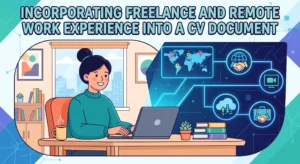
The traditional nine-to-five corporate job is no longer the only valid form of professional experience, and the gig economy has completely reshaped how modern careers are structured. If you have spent significant time navigating freelance contracts, independent consulting, or remote work setups, you must learn how to properly leverage these highly entrepreneurial roles to your advantage. When you create professional resume sections specifically for contract work, you should group multiple short-term projects under a single, unified “Independent Consultant” or “Freelance Specialist” header to prevent your document from looking erratic, overly disjointed, or chaotic.
Under this main overarching header, clearly list three or four of your absolute most prestigious clients or most complex deliverables. Treat these freelance projects with the exact same level of profound respect and aggressive metric-driven detailing as you would a full-time corporate role. Furthermore, explicitly mention your deep proficiency with modern remote collaboration software, async communication protocols, and self-directed time management methodologies. In an era where hybrid work is the dominant corporate model, thoroughly proving that you can operate highly autonomously, deliver massive results without intense micromanagement, and maintain strict discipline in a completely isolated remote environment is an incredibly lucrative, highly sought-after selling point for modern employers.
14. Essential Sections: Education, Certifications, and Continuous Learning
The strategic placement and detailed formatting of your educational background heavily depend on where you currently stand in your overall career trajectory. If you are a highly experienced professional with a decade of proven industry dominance, your formal degrees are significantly less important than your real-world corporate track record. In this scenario, you should aggressively push your education section to the very bottom of the page when you create professional resume layouts. However, if you are a recent graduate or currently executing a massive industry pivot, your academic credentials, high-level coursework, and comprehensive thesis projects should be positioned much closer to the top to heavily establish baseline credibility.
Beyond standard university degrees, modern employers place an exceptionally high premium on continuous, self-directed learning and highly specialized micro-credentials. Including a robust, dedicated section for relevant industry certifications, intensive bootcamps, and advanced online masterclasses forcefully signals that you are deeply invested in staying ahead of rapid technological curves. Ensure that you only list highly relevant, officially recognized credentials rather than obscure, unverified tutorials. If you want a competitive edge, accessing resources regarding leveraging continuous education for career advancement will teach you how to properly frame your ongoing training. An applicant who consistently upgrades their own skill set is viewed by HR directors as a rapidly appreciating asset, rather than a rapidly depreciating corporate liability.
15. Optimizing Your Contact Information and Digital Footprint
Your contact information section might seem like the simplest part of the document, but it is often where candidates make massive, outdated errors. When you create professional resume headers today, you must realize that privacy standards and digital footprints have radically evolved. You no longer need to include your full physical mailing address; doing so not only presents a potential security risk but can also trigger subconscious location bias if a recruiter feels your daily commute would be too grueling. Instead, simply list your current city and state, or explicitly note if you are fully open to remote relocation. Your phone number and a highly professional email address—preferably one that strictly relies on variations of your first and last name rather than outdated nicknames or random numbers—are absolutely non-negotiable. However, the most critical element of a modern contact header is the inclusion of your highly optimized digital footprint. You must provide a clean, customized hyperlink to your fully updated LinkedIn profile, ensuring the recruiter can instantly verify your professional network and peer endorsements. If you work in a creative, technical, or highly visual field, you must also include a direct link to your digital portfolio, GitHub repository, or personal website. By streamlining this top section, you immediately project a highly polished, tech-savvy image that commands respect from the moment the file is opened.
16. The Power of Action Verbs and High-Impact Language
The actual vocabulary you select when you create professional resume descriptions fundamentally dictates how your leadership capabilities and overall competence are perceived by elite hiring managers. Using weak, entirely passive phrases like ‘was responsible for,’ ‘helped with,’ or ‘worked on’ instantly diminishes your actual authority and makes you sound like a minor, highly replaceable cog in a massive corporate machine. To aggressively command respect and secure premium interview slots, you must strictly utilize high-impact action verbs at the absolute beginning of every single bullet point. Instead of stating that you ‘helped a team,’ declare that you ‘orchestrated,’ ‘mobilized,’ or ‘spearheaded’ a cross-functional initiative.
Rather than saying you ‘made new processes,’ confidently state that you ‘architected,’ ‘engineered,’ or ‘systematized’ heavily optimized workflows. This highly dynamic, assertive language psychologically forces the reader to view you as a dominant, proactive catalyst for positive business change. You can further master this technique by deeply analyzing the specific vocabulary utilized in your target company’s mission statement, organically mirroring their unique corporate dialect. Incorporating a robust high-impact action verb strategy instantly elevates the perceived monetary value of your labor, transforming standard daily tasks into extraordinary executive achievements that command top-tier compensation.
17. Designing for Readability: Fonts, Margins, and Colors
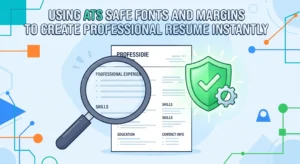
A massive, often overlooked aspect of application success is the actual visual psychology of the document itself. When you attempt to create professional resume layouts, you must strictly avoid the dangerous temptation to over-design the page with chaotic, highly experimental visual elements. Elite recruiters and highly sensitive Applicant Tracking Systems both heavily favor clean, minimalist, and deeply traditional typographical choices. You must absolutely stick to highly legible, ATS-safe sans-serif or serif fonts such as Arial, Calibri, Helvetica, or Garamond. Utilizing overly elaborate, script-style fonts might look highly creative to you, but it significantly slows down reading comprehension and frequently causes deep parsing errors within automated software filters.
In addition to safe font selection, strict margin spacing plays a critical role in preventing recruiter visual fatigue. You must maintain standard margins of at least half an inch to one full inch on all sides, ensuring the text does not feel overwhelmingly crammed onto the page. You should heavily utilize negative space—or clear whitespace—to naturally guide the reader’s eye downward through your various key sections. Avoid using aggressive, neon color palettes; if you choose to incorporate color for stylistic personal branding, stick to deep, muted tones like navy blue, dark slate, or forest green strictly for section headers. Clean aesthetics consistently equate to perceived organizational competence.
18. Top 5 Deadly Resume Mistakes That Guarantee Rejection
Even highly experienced, executive-level professionals consistently sabotage their own lucrative career prospects by committing easily avoidable, catastrophic formatting and content errors. The single most lethal mistake you can make when you create professional resume submissions is failing to rigorously proofread your final file, allowing blatant grammatical typos or spelling errors to slip through undetected. Hiring managers view typos not just as simple, honest mistakes, but as glaring indicators of profound carelessness and a severe lack of baseline attention to detail. Another massive red flag is the inclusion of an outdated, deeply self-serving ‘Objective Statement’ rather than a modern, high-value ‘Executive Summary.’
Furthermore, filling your document with highly irrelevant personal hobbies, controversial political affiliations, or completely unrelated odd jobs aggressively dilutes your core professional message and wastes extremely valuable page space. You must also strictly avoid aggressive keyword stuffing—the act of mindlessly copying and pasting the exact job description in a tiny, invisible font to trick the ATS algorithm. Modern HR software is highly sophisticated and instantly flags this manipulative, black-hat tactic, resulting in an automatic, permanent ban from the company’s internal applicant database. You can review our detailed guide on avoiding deadly application red flags to ensure your carefully crafted document flawlessly survives the initial, brutal digital screening process.
19. Proofreading and the Crucial Final Review Process
The final review phase is arguably the most critical step in the entire document creation lifecycle, yet it is exactly the one most frequently rushed by exhausted, heavily stressed job seekers. After spending dozens of hours staring at a bright computer screen attempting to create professional resume content, your brain naturally develops a profound cognitive blindness to its own unique textual errors. Your mind will automatically fill in missing words and smoothly gloss over misspelled terminology simply because it already knows what the sentence is supposed to communicate. To effectively break this dangerous psychological cycle, you must forcefully step away from the document for at least twenty-four hours before conducting your final edit.
When you finally return to the text, read the entire file aloud, very slowly; this brilliant tactic forces your auditory processing centers to catch clunky, poorly phrased sentences that your tired eyes missed entirely. Additionally, you should actively leverage advanced digital proofreading tools, but do not rely on them blindly, as they often severely misunderstand deep, industry-specific jargon. Most importantly, you must always export your final, deeply polished file strictly as a PDF document. Submitting a raw Microsoft Word file is incredibly risky, as complex formatting, custom margins, and nested bullet points will almost certainly break or shift dramatically when opened on a different corporate operating system.
20. FAQ: Frequently Asked Questions About Professional Resumes
As we conclude this definitive, highly actionable masterclass, it is essential to aggressively address the most persistent, universally debated inquiries that consistently plague modern job seekers. A massive volume of the extreme anxiety surrounding the complex application process stems entirely from deeply conflicting advice scattered across the internet. When you strive to create professional resume portfolios, understanding the rigid, data-driven truths behind these common FAQs will quickly save you countless hours of needless frustration. One of the most fiercely debated topics is the strict length of the document itself. As a universal rule, if you have less than ten years of highly relevant industry experience, you must aggressively condense your entire history into a single, punchy, hyper-focused page.
If you are a senior-level executive with decades of complex achievements, a two-page document is perfectly acceptable, provided every single line adds tangible, undeniable value. Another critical question involves the inclusion of a professional headshot. In strict legal compliance with anti-discrimination labor laws in the United States, Canada, and the United Kingdom, you must absolutely never include a photograph, as it heavily exposes the employer to massive unconscious bias liabilities. However, if you are actively applying in certain European, Middle Eastern, or Asian labor markets, a highly professional headshot is frequently expected and heavily normalized within the local corporate culture.
21. How often should I update my resume when not actively job searching?
A massive, fundamental misunderstanding among the general workforce is the dangerously flawed belief that your application document should only be touched when you are desperate for a new job. If you truly wish to maintain elite upward mobility and absolute financial security, you must treat your CV as a highly dynamic, endlessly evolving ‘living document.’ You should proactively schedule strict time to update and refine your professional profile every six months, regardless of your current employment satisfaction. Human memory is incredibly fragile and highly unreliable; if you wait three entire years to write down your biggest corporate achievements, you will inevitably forget the exact revenue metrics, the specific technical software you utilized, and the highly impressive scale of your successful projects.
By actively maintaining your file on a strict bi-annual schedule, you ensure that you are always fully prepared for unexpected, highly lucrative career opportunities, sudden corporate layoffs, or internal promotion interviews. Tracking your quantifiable achievements in real-time allows you to continuously create professional resume iterations that are consistently razor-sharp, deeply accurate, and overflowing with undeniable data. Staying perpetually ready eliminates massive amounts of stress and guarantees that you will never miss out on a life-changing career leap simply because your critical paperwork was heavily outdated.



Leave a Reply