
The Resume Black Hole: What Is an Applicant Tracking System?
Welcome to the highly competitive modern job hunt, where your very first interviewer is rarely a human being with empathy and intuition. Instead, it is an incredibly rigid, automated software program explicitly designed to filter out unqualified candidates before they ever reach a hiring manager’s desk. This invisible, silent gatekeeper is universally known throughout the corporate world as an Applicant Tracking System, or ATS for short.
For most ambitious job seekers aiming for high-level positions, understanding how to strategically navigate this digital landscape is the single most critical factor in landing a lucrative interview. You might possess the most impressive professional background, hold the highest academic degrees, and boast perfect executive references, but if your application document is not inherently readable by these complex algorithms, digital candidate profile will simply disappear into the dreaded resume black hole forever.
To successfully bypass this immense technological barrier, you must thoroughly learn how to make your resume friendly from the ground up. This involves deliberately stripping away overly creative design elements and focusing intensely on the core textual data that the software is explicitly programmed to extract and analyze. Let us deeply explore the fundamental rules of engagement required to beat this system and secure your spot at the interview table.
Key Takeaways:
• Understand the Algorithm: Learn exactly how parsing technology reads and categorizes digital candidate profilepersonal data.
• Format for Machines: Eliminate complex graphics, tables, and dual columns immediately.
• Optimize with Keywords: Mirror the exact job description to achieve a perfect match score.
• Secure Human Review: Structure your achievements to impress the recruiter once the software passes you through.

Why Over 75% of Resumes Are Rejected by ATS Software Instantly
It is a staggering and often demoralizing reality in today’s corporate recruitment landscape that approximately three-quarters of all submitted applications are permanently discarded before a human recruiter even clicks on them. This immense, automated rejection rate is not necessarily because the participating candidates lack the required professional skills, necessary education, or relevant industry experience needed to succeed in the role.
More often than not, this mass rejection is directly caused by surprisingly simple formatting errors and a severe lack of targeted keywords optimization within the document text. The automated resume parsing algorithm systems are incredibly rigid in how they interpret data sets, and they absolutely do not possess the human capability to infer meaning from poorly structured text or abstract descriptions of optimization your past duties.
When a highly qualified, brilliant professional uses an overly creative template filled with intricate sidebars and custom typography, the Applicant Tracking System cannot parse the information accurately. The software rapidly becomes confused, scrambles your professional history, and ultimately scores your digital candidate profile as a zero percent match for the open position, effectively ending your candidacy right then and there.
As an elite HR expert who has audited thousands of corporate application portals, I have witnessed countless exceptional candidates lose out on their absolute dream jobs simply because they failed to understand the highly rigid nature of modern . You must recognize immediately that these enterprise software systems are built strictly for processing efficiency, not for human empathy.
Therefore, aggressively prioritizing an applicants tracking systems friendly formatting strategy over elaborate visual aesthetics is absolutely mandatory in today’s job market. This technical approach is the only proven method to ensure your years of hard work, dedication, and expensive education are actually recognized and fairly evaluated by the hiring team.
The Secret Mechanics: How Resume Parsing Actually Works
To truly master the delicate art of beating the digital applicant tracking system friendly , you must first deeply understand the secret mechanics operating behind standard resume parsing technology. When you confidently click the submit button on any corporate application portal, your beautifully crafted document is instantly converted into raw, unformatted plain text by the backend parsing algorithm.
The system then systematically and ruthlessly scans this plain text document searching for highly recognizable headers, such as “Work Experience,” “Education,” and “Skills.” If you attempt to be clever and use unconventional headers like “My Professional Journey” or “What I Bring to the Table,” the parser will utterly fail to categorize your data, effectively erasing your employment history from its internal database entirely.
Once your critical data is successfully categorized into the correct digital buckets, the software immediately begins resume parsing algorithm for specific keyword that perfectly matches the strict parameters set by the hiring manager. It looks relentlessly for exact key phrases, specific software proficiencies, and relevant industry terminology in order to assign you an overall candidate match score.
This critical matching score strictly dictates your visibility and ranking inside the employer’s management dashboard. If your computed score falls below a predetermined administrative threshold—which is very often set around the eighty percent mark—you are automatically moved to the rejected pile without triggering any manual human review whatsoever.
The most sophisticated and expensive platforms on the market today do utilize advanced natural language processing to evaluate professional context, but they are still fundamentally reliant on clear, highly predictable text structures. Therefore, presenting your long-term career trajectory in a totally logical, machine-readable format is the unshakeable foundation of any successful, modern job application process.
Step 1: Choosing the Perfect ATS Friendly Resume Format
The very first and arguably most pivotal step in completely transforming your job application strategy is aggressively choosing the perfect ATS friendly resume format. The ultimate foundation of your interviewing success relies entirely on how the underlying digital structure is built, long before you even begin drafting your compelling bullet points and professional summaries.
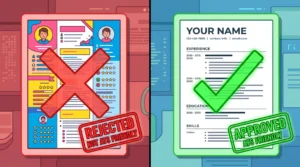
The golden, unbreakable rule of effective ATS formatting is absolute simplicity above all else. You must ruthlessly strip away any visual element that could potentially confuse the fragile parsing engine. This means definitively saying goodbye to those heavily designed, multi-colored templates you might easily find on popular graphic design platforms, which dangerously prioritize visual flair over digital readability.
Instead of risking your career on a flashy design, you should purposefully utilize a clean, highly straightforward Microsoft Word document or a widely accepted standard PDF, depending entirely on the specific upload instructions provided in the job description. The resume parsing algorithm software needs to effortlessly read your document from left to right and top to bottom in a highly seamless motion.
If your complex layout subtly forces the system to jump around the page to find critical dates, exact job titles, or previous company names, the extracted data will instantly become a jumbled, unreadable mess. A standard top-down approach guarantees that the internal algorithm maps every single professional detail to the correct corresponding field in your digital candidate profile.
Always remember, as you structure your files, that your ultimate overarching goal at this early stage is 100% machine comprehension. A beautifully designed, highly artistic document is completely worthless to your career progression if the automated gatekeeper cannot translate your impressive professional achievements into searchable database metrics.
Chronological vs. Functional: Which Layout the applicant tracking system friendly Prefer
When carefully selecting your overarching document layout, you will typically encounter two primary structural options widely debated by career coaches: the standard chronological format and the heavily grouped functional format. In the high-stakes context of learning how to beat the applicant tracking system, there is one clear and absolutely undisputed winner that you must utilize without fail.
The classic reverse-chronological format is universally preferred by every major enterprise software platform operating in the modern recruitment industry today. This highly traditional layout explicitly lists your most recent work experience first and steadily works backward in time, creating a highly predictable temporal timeline for the rigid parsing algorithm to easily follow and digest.
Because this specific structure has served as the global industry standard for decades, ATS algorithms are explicitly programmed from the ground up to trace this exact pattern. They fully expect to find a recognizable company name, immediately followed by a professional job title, precise employment dates, and finally, a bulleted list of your specific responsibilities and major achievements.
Conversely, the functional layout—which deliberately groups your vast experience by broad skill categories rather than chronological jobs—is an absolute processing nightmare for modern parsing technology. The system struggles immensely to logically connect your listed soft and technical skills with specific dates of employment, leading directly to massive data gaps in your extracted digital candidate profile.
Even if you happen to have significant employment gaps or are currently undergoing a massive professional career change, you must strongly resist the urge to use a functional layout to hide these facts. Sticking loyally to the trusted reverse-chronological structure guarantees that the software will successfully extract your full professional history without generating critical system errors.
The Truth About Columns, Tables, and Complex Designs
One of the most destructive and heartbreaking mistakes ambitious job seekers make is attempting to stand out by incorporating complex visual designs into their vital application documents. While these beautiful elements might genuinely impress a human reader holding a physical piece of paper, they are highly toxic and nearly unreadable to automated screening software programs.
You must absolutely avoid using multiple columns under any circumstances when formatting your document. When a standard parsing engine encounters a dual-column layout, it typically reads straight across the page from left to right, completely ignoring the invisible visual barrier between the columns and instantly destroying the coherent grammatical structure of your carefully written sentences.
Similarly, complex tables and embedded text boxes are frequently ignored or entirely scrambled by older, less sophisticated Applicant Tracking Systems. If you decide to hide your most valuable technical skills or your important contact information securely inside a shaded formatting box, there is a exceptionally high probability that the software will simply delete that crucial data entirely.
Furthermore, vivid graphics, vector icons, company logos, and professional portrait photographs are strictly forbidden in any highly optimized application strategy. The resume parsing algorithm software simply cannot “see” colorful images; it can only aggressively read standard text. Including these heavy visual elements can sometimes cause the entire parsing process to freeze or crash, resulting in an automatic, silent rejection.
To guarantee maximum system compatibility across all major HR platforms, you must bravely rely exclusively on standard formatting tools like strategic bolding, tasteful italics, and basic bullet points to meticulously organize your text. Let your impressive career achievements and strict formatting rules do the heavy lifting for you, rather than dangerously relying on inherently risky graphic design choices.
Step 2: Mastering Keywords Optimizations and Contextual Matching
Now that you have established a rock-solid, structurally sound document foundation, the absolute next critical phase is mastering the highly nuanced art of keywords optimization. You must conceptually view your target job description not simply as a list of desired employer requirements, but rather as an explicit, highly detailed cheat sheet containing the exact vocabulary the applicant tracking system is meticulously programmed to find. If your submitted document does not precisely mirror this required vocabulary, your structural perfection will ultimately mean nothing.
The algorithm operates fundamentally on contextual matching, calculating a complex percentage score based entirely on how frequently and naturally your professional terminology aligns with the employer’s original job posting. Many job seekers make the fatal error of assuming that synonymous terms are perfectly acceptable. For example, if the job description specifically demands “project management,” but your resume proudly lists “task coordination,” the rigid bot will aggressively deduct points, utterly failing to recognize that these two terms essentially represent the exact same core competency.
Therefore, you must deliberately learn to speak the precise linguistic dialect of the specific company you are targeting. This involves a comprehensive, line-by-line analysis of the job posting to actively isolate mandatory skills, preferred qualifications, and core industry methodologies. By strategically integrating these exact phrases into your professional summary, skills section, and historical bullet points, you dynamically force the ATS software to instantly recognize you as a top-tier, high-priority candidate worthy of an immediate human interview.
Furthermore, attempting keyword stuffing—the outdated practice of invisibly hiding hundreds of white-text keywords in the margins—will inevitably trigger an automatic disqualification flag in modern, highly advanced AI parsing systems. You must always prioritize natural, highly coherent sentence structures while seamlessly weaving these vital corporate keywords into your verified professional achievements.
How to Decode Job Descriptions for Hidden Keywords
Decoding modern job descriptions is a highly specialized skill that requires intense concentration and strategic foresight. Whenever a corporate hiring manager initiates a new recruitment campaign, they manually input a stringent list of mandatory parameters into the backend system. Your primary objective as an elite candidate is to accurately reverse-engineer this hidden digital scorecard by thoroughly dissecting the public-facing job advertisement. You must learn to definitively differentiate between generic corporate buzzwords and the highly specific technical requirements that actually carry heavy algorithmic weight.
Start your decoding process by physically highlighting every single noun and active verb directly related to the required daily tasks and technical proficiencies. Pay extremely close attention to the specific software platforms, regulatory certifications, and specialized industry methodologies mentioned in the “Requirements” or “What You Will Do” sections. If a job posting mentions a specific CRM software like Salesforce three separate times, you can be absolutely certain that “Salesforce” is a primary, heavily weighted keyword that must appear prominently in your own application document.
Furthermore, you must rigorously analyze the exact phrasing and capitalization used by the employer. If they specifically ask for an “SEO Specialist,” do not refer to yourself broadly as a “Digital Marketing Expert” in your current job title header. The applicant tracking system lacks human intuition and relies strictly on exact-match data evaluation to process thousands of files simultaneously.
By deliberately mirroring their exact corporate terminology, you effectively neutralize the digital barrier and drastically elevate your overall compatibility score within their proprietary candidate database. This exact-match strategy guarantees that your application survives the brutal initial scan and proceeds directly to the hiring manager’s highly exclusive shortlist for immediate review.
Hard Skills vs. Soft Skills: Balancing the Algorithm
When aggressively optimizing your application for maximum ATS visibility, it is absolutely crucial to understand the fundamental difference in how resume parsing algorithm evaluate hard skills compared to soft skills. Hard skills are quantifiable, easily verifiable technical abilities—such as proficiency in Python programming, advanced financial modeling, or fluent bilingual communication. These highly tangible competencies are the absolute primary drivers of your ATS matching score. The software can effortlessly scan for these exact terms and instantly verify if you meet the minimum technical threshold for the role.
Conversely, soft skills—such as dynamic leadership, empathetic communication, or proactive problem-solving—are largely subjective traits that are notoriously difficult for rigid algorithms to accurately measure or verify. While modern applicant tracking systems do technically scan for these abstract terms, simply listing “excellent team player” in a generic skills column carries virtually zero algorithmic weight. The bots are programmed to actively look for concrete contextual evidence rather than just empty, unverified claims.
To successfully balance this complex digital equation, you must strategically embed your crucial soft skills directly into the quantifiable achievements of your hard skills. Instead of just stating you are a “strong leader,” you should craft a detailed bullet point demonstrating how you managed a diverse team using empathetic conflict resolution to increase overall department productivity.
This sophisticated, hybrid approach satisfies the rigid keyword requirements of the applicant tracking system friendly while simultaneously impressing the human HR manager who eventually reads your file. You essentially provide the algorithm with the exact data points it craves, while wrapping those data points in a compelling human narrative that demands professional respect and immediate attention from the recruitment team.
Watch this expert breakdown on optimizing your resume for ATS screening , keyword optimization:
Step 3: Structuring Your Professional Experience Section Perfectly
The professional experience section is unquestionably the most heavily scrutinized area of your entire application, not only by human hiring managers but predominantly by the unforgiving applicant tracking system. This critical section is where the parsing algorithm strictly demands absolute chronological clarity and formatting consistency. If you fail to structure your historical employment data logically, the software will inevitably scramble your timeline, misinterpret your past seniority, and immediately reject your candidacy based on a falsely perceived lack of required experience.
To guarantee a flawless data extraction process, you must utilize a universally recognized, highly standardized heading convention for every single past role. You must always start by clearly listing the official company name, followed immediately by your exact professional job title, the specific geographic location, and the precise month and year of your employment tenure. You must explicitly use standard date formats, such as “January 2020 – December 2023” or “01/2020 – 12/2023,” because confusing qualitative formats like “Winter 2020” will invariably trigger a catastrophic parsing failure.
Moreover, you must absolutely resist the dangerous temptation to use complex tables, heavily shaded text boxes, or embedded graphical elements to visually separate this critical employment data. You must relentlessly maintain a strict, top-to-bottom linear flow that guides the digital crawler smoothly through your progressive career history without generating sudden computational errors.
By consciously providing the algorithm with a highly predictable, mathematically structured dataset, you completely eliminate the terrifying risk of your most impressive professional achievements being accidentally deleted. keyword optimization standardized resume structuring methods serves as your ultimate insurance policy against the brutal technical glitches that ruin thousands of careers daily.
The Exact Formula for ATS-Optimized Bullet Points
Writing highly effective, ATS-optimized bullet points requires a fundamental shift in your professional mindset; you must immediately transition from writing passive job descriptions to crafting aggressive, deeply analytical impact statements. The resume parsing algorithm scanning algorithms are specifically programmed to seek out clear, actionable language that definitively proves your workplace competency. Starting your crucial bullet points with weak, passive phrases like “Responsible for” or “Duties included” instantly diminishes your professional authority and wastes incredibly valuable keyword real estate within the document.
Instead, you must rigorously employ the proven XYZ formula to construct every single bullet point in your employment history. This highly effective methodology dictates that you should clearly state what you accomplished (X), accurately measure the tangible impact of that accomplishment (Y), and explicitly detail the specific skills or tools you utilized to achieve it (Z). This structured approach densely packs your sentences with vital industry keywords while providing essential semantic context.
For example, an optimally crafted bullet point should read: “Spearheaded the successful migration of legacy CRM data to Salesforce, effectively reducing daily data retrieval times by an impressive 40%, by utilizing advanced Python scripting and automated API integrations.” This highly precise, deeply technical phrasing completely satisfies the rigid algorithmic scanning requirements and leaves zero ambiguity regarding your exact capabilities.
Furthermore, this aggressive strategy simultaneously paints a vivid, highly compelling picture of your exceptional capabilities for the human hiring manager. When they eventually read your file, they immediately see a highly motivated, results-driven professional who fundamentally understands how to leverage complex tools to generate massive, undeniable value for the organization.
Quantifying Your Achievements for Maximum Impact
If there is one universal truth in the highly complex world of algorithmic resume optimization, it is that applicant tracking systems absolutely love hard numbers, strict percentages, and verifiable monetary values. Integrating concrete mathematical data into your professional achievements is the single fastest, most effective way to dramatically elevate your candidate ranking score. When the parsing software detects specific numerical figures, it automatically flags your application as highly authoritative, definitively separating you from the thousands of candidates who rely on vague, unquantifiable claims.
You must ruthlessly audit your current employment history and actively seek out every possible opportunity to inject specific metrics. Did you actively manage a corporate budget? You must state the exact dollar amount clearly. Did you successfully lead a cross-functional team? You must explicitly specify the exact number of direct reports you supervised. Did you significantly improve overall operational efficiency? You must clearly define the exact percentage increase and the specific timeframe.
This aggressive numerical optimization serves a highly critical dual purpose in the modern corporate hiring process. First, it completely satisfies the rigid data-extraction protocols of the automated software, ensuring you successfully pass the initial digital screening phase without being flagged as a low-value applicant. Second, it provides undeniable leverage during the crucial salary negotiation phase.
You are no longer just making empty promises to a potential employer; you are providing verified historical evidence of your ability to generate highly lucrative results. By quantifying your past success, you mathematically prove your future worth, forcing both the artificial intelligence and the human recruiter to acknowledge your elite status within the highly competitive candidate pool.
How to Handle Employment Gaps and Title Discrepancies
Navigating significant employment gaps and wildly inconsistent corporate job titles is arguably one of the most stressful challenges when aggressively optimizing your application for automated tracking systems. The harsh reality is that rigid parsing algorithms are explicitly designed to flag long periods of unemployment as a high-risk factor, potentially triggering an automatic rejection if these critical gaps are not handled with extreme strategic care. You cannot simply delete dates or obscure the timeline, as this will immediately cause a catastrophic system error.
To strategically manage significant employment gaps, you must proactively fill that empty chronological space with highly relevant, verifiable professional development activities. If you spent a year aggressively upskilling, you should formally list “Continuing Education” or “Independent Consultant” as your official job title for that specific period, ensuring you maintain the continuous chronological flow that the applicant tracking system friendly demand. You must then carefully bullet-point the specific certifications you acquired or the freelance projects you successfully completed.
Regarding title discrepancies, you must carefully balance absolute honesty with required algorithmic optimization. If your previous company gave you an obscure, highly creative title like “Director of First Impressions,” the will completely fail to recognize that you were actually a Corporate Receptionist. The system will inherently penalize you for not matching the target keywords.
In this highly specific scenario, you are officially permitted to use a clever dual-title strategy. You should list your official title, immediately followed by the standard industry equivalent in parentheses, such as “Director of First Impressions (Corporate Receptionist).” This highly sophisticated tactic completely satisfies both the rigorous background check requirements and the strict algorithmic keyword scanners simultaneously.
Step 4: Elevating Your Education and Skills Sections
The education and technical skills sections often serve as the definitive algorithmic tie-breakers when automated sorting platforms evaluate candidates with remarkably similar professional employment backgrounds. If you do not logically structure these vital sections with extreme mathematical precision, you dangerously risk losing highly valuable matching points that could otherwise instantly propel your application to the absolute top of the recruiter’s digital management dashboard. When formatting your formal academic history, you must always explicitly state the complete, unabbreviated name of your university, the exact formal degree you earned, and the corresponding graduation year.
You must strictly avoid using potentially confusing abbreviations like “B.S.” without also explicitly spelling out “Bachelor of Science,” because older applicant tracking software might exclusively search the database for the fully spelled-out degree keyword. Furthermore, your dedicated professional skills section must aggressively act as a highly concentrated, high-density keyword matrix. Instead of keyword optimization using vague, conversational sentences to lightly describe your technical competencies, utilize a highly structured, bulleted list containing specific software platforms, programming languages, and industry methodologies.
This heavily concentrated formatting approach allows the digital crawler to rapidly scan, process, and permanently verify your core technical qualifications in mere milliseconds. You must intelligently group these distinct abilities into logical, readable categories—such as “Technical Proficiencies,” “Data Analytics Platforms,” or “Project Management Frameworks”—to ensure maximum parsing efficiency and guarantee complete system comprehension of your overall professional value proposition.
Where to Place Certifications for Maximum Visibility
In the incredibly competitive and rapidly evolving job market, specialized industry certifications frequently carry just as much algorithmic weight and hiring prestige as traditional, highly expensive four-year academic university degrees. However, if you accidentally hide these extremely crucial credentials at the absolute bottom of a lengthy, multi-page application document, there is a significant mathematical probability that the tracking software will temporarily time out or simply stop scanning before it ever extracts that vital data.
To completely mitigate this disastrous technological risk, you must strategically create a distinct, highly visible section clearly titled “Licenses and Certifications” positioned immediately below your professional summary or your primary skills matrix. This deliberate architectural placement guarantees that the automated gatekeeper instantly registers your specialized qualifications during its very first, incredibly rapid sweep of the uploaded document, locking in your high match score early in the process.
Whenever you list a newly acquired certification, you must explicitly include the official corporate name of the issuing organization, the exact title of the credential, and the official expiration date if it is practically applicable to the role. Integrating a highly sophisticated ATS friendly resume strategy specifically tailored for your continuing technical education history is absolutely paramount for successfully securing lucrative, high-level corporate positions today.
Decoding ATS-Friendly File Types: PDF vs. Word Document
One of the most fiercely debated, highly contentious topics within elite executive career coaching circles is definitively determining the absolute best digital file format for successfully bypassing automated applicant screening software. Historically, standard Microsoft Word documents (.docx) were universally considered the safest, most statistically reliable option simply because rudimentary parsing algorithms could effortlessly extract plain text from them with virtually zero backend complications or structural errors.
However, as enterprise-level corporate recruitment technology has dramatically and irreversibly advanced into 2026, the universally accepted industry standard has definitively shifted toward highly optimized, text-based PDF files. A cleanly formatted, standard PDF inherently preserves your exact visual layout effortlessly, guaranteeing that the human hiring manager ultimately sees your professional document exactly as you originally designed it, completely free of any embarrassing system font substitutions or sudden margin expansion errors.
That being explicitly said, you must absolutely ensure that your selected PDF was digitally generated directly from a robust text-based word processor, rather than mistakenly scanned as a flat, unreadable image file. If you accidentally save a flattened photograph of your application as a PDF, the highly sensitive tracking software will only process a completely blank page, resulting in an immediate, deeply devastating silent rejection from the candidate pool.
Common ATS Red Flags and Fatal Formatting Mistakes
Even after you have meticulously optimized all of your core industry keyword optimization and perfectly structured your entire chronological professional history, there are still several hidden, highly dangerous technical traps that can completely derail your entire job hunting campaign overnight. These surprisingly common ATS red flags typically stem directly from an understandable, yet deeply misguided, personal desire to make your application visually unique or artistically modern to impress human eyes.
The absolute most destructive, career-ending formatting mistake you can possibly execute is utilizing invisible white text to secretly hide hundreds of targeted job description keyword optimization in the absolute margins of your document. While this highly deceptive, unethical tactic may have actually successfully tricked primitive software algorithms over a decade ago, modern AI-driven applicant tracking systems are now specifically programmed to instantly detect and aggressively penalize this blatant keyword optimization stuffing strategy.
If the intelligent system suddenly flags your uploaded file for white-text stuffing, you will not only be unceremoniously rejected for the current open role, but you will also likely be permanently, irreversibly blacklisted within that specific corporation’s internal global HR database forever. Another massive, easily avoidable error is intentionally using obscure, overly stylized custom fonts that the automated parsing software simply does not currently possess in its internal master font library.
Why Headers and Footers Destroy Your Data Extraction
Many ambitious, highly educated professionals inherently rely heavily on standard document headers and footers to neatly organize their vital personal contact information, falsely assuming it intelligently saves extremely valuable page space for the main professional text. This seemingly harmless, commonplace formatting habit is actually one of the most statistically fatal technical errors you can possibly commit when aggressively preparing your digital corporate application for submission.
The vast majority of currently operating legacy applicant tracking software systems will completely and permanently ignore any typed text that is physically placed within the formal structural header or footer margins of a Microsoft Word or PDF document. If you foolishly place your full legal name, your primary professional email address, your direct mobile phone number, and your highly optimized LinkedIn URL securely inside the top header, the algorithm will extract absolutely nothing at all.

As a direct result of this catastrophic parsing failure, your digital candidate profile will be generated entirely blank internally, making it completely and utterly impossible for the corporate recruitment team to ever contact you for a highly anticipated interview. To definitively guarantee that your absolutely critical contact details are successfully captured, you must place all of this vital information squarely within the main accessible body text area, centered at the absolute top of the page.
Frequently Asked Questions About ATS Resume Optimization
Navigating the incredibly complex, highly frustrating maze of modern enterprise recruitment software naturally generates a massive, continuous multitude of strategic technical questions from highly qualified job seekers around the globe. One of the absolute most frequently asked questions on career forums is whether it is practically necessary to create a brand new, highly customized document file for every single corporate job application submitted online.
The incredibly unfortunate but absolutely undeniable professional truth is that yes, aggressive textual customization is functionally and structurally mandatory in the highly competitive hiring landscape. Because the proprietary matching algorithm relies almost entirely on directly comparing your submitted text to the specific job description, a generic, highly lazy one-size-fits-all approach will consistently yield a disastrously low, unviable compatibility score every time.
You must willingly dedicate the required time to painstakingly adjust your core industry keyword optimization, strategically reorder your primary technical bullet points, and heavily emphasize different leadership skills based entirely on the unique, specific demands of each individual employer. By heavily leveraging advanced career planning optimization strategies, you can systematically streamline this tedious customization process, allowing you to rapidly deploy highly lethal variations of your master file directly into the system.
Can I Use a Two-Page Resume keyword optimization for Applicant Tracking Systems?
The legendary, age-old industry debate surrounding the supposedly ideal length of a professional job application has finally been definitively and completely settled by the universal, global adoption of digital automated screening technology. If you personally possess more than seven to ten years of highly relevant, continuous, aggressive industry experience, using a comprehensive two-page document is not only perfectly acceptable, it is now actively encouraged by senior technical HR professionals.
The invisible automated tracking system explicitly does not possess a strict psychological page limit; it simply craves massive, overwhelming amounts of highly structured, keyword-rich historical data to accurately calculate your overall professional baseline competency. Confining a brilliant fifteen-year career into a single, tightly crowded page inevitably forces you to aggressively delete highly critical keywords, vital technical achievements, and major corporate leadership milestones that the algorithmic system specifically needs.
However, you must strategically ensure that your absolute most impressive credentials, your highest verified academic degrees, and your primary, heavily requested technical skills are prominently displayed on the absolute very first page. If the digital parsing bot instantly confirms your mandatory minimum qualifications directly on page one, it will gladly and rapidly continue scanning page two to accurately calculate your final cumulative ranking score, officially securing your interview.





Leave a Reply